
After Action Report
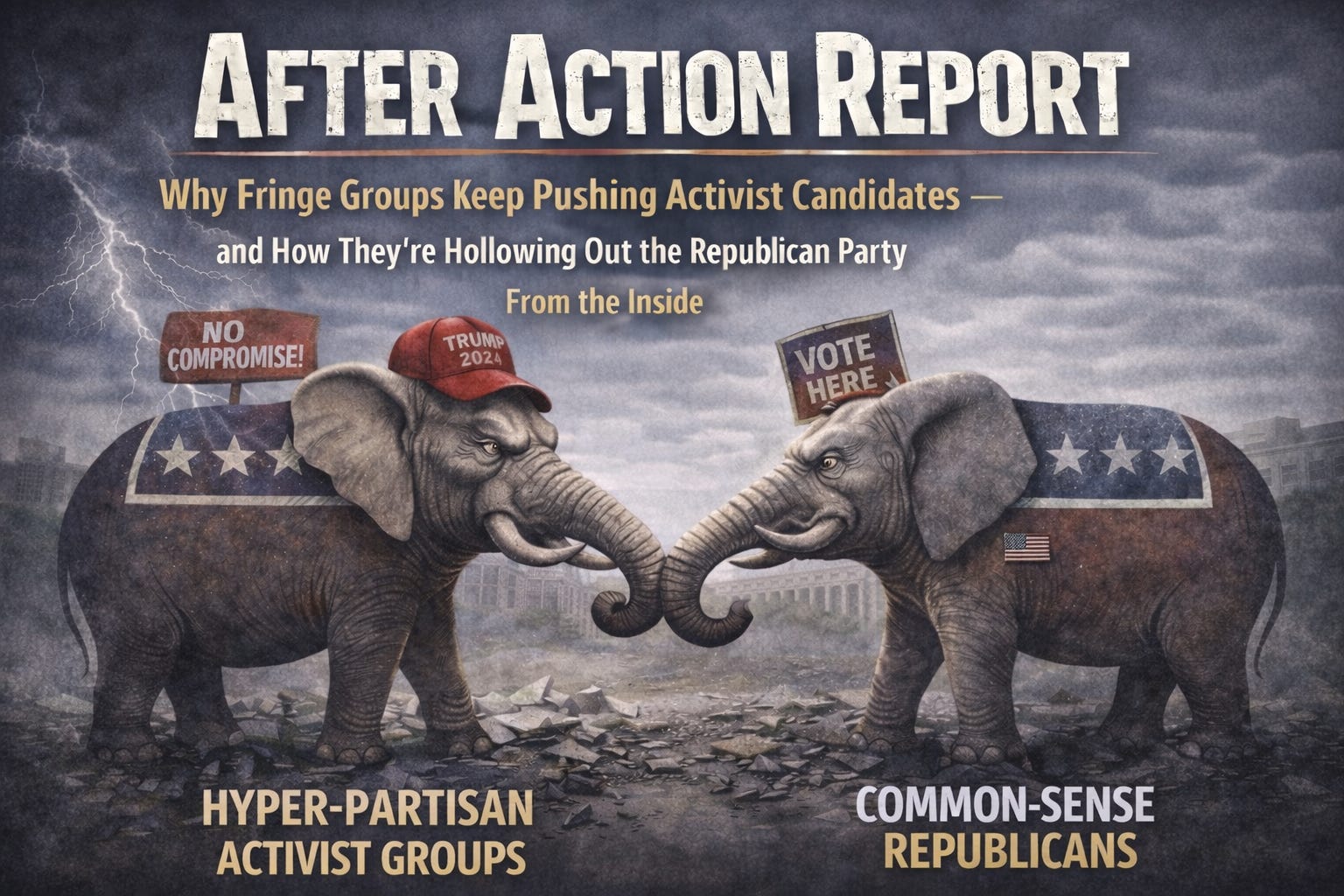
Why Peripheral Party Factions Keep Pushing Activist Candidates — and How They’re Hollowing Out the Republican Party From the Inside

Welcome back.
If you were paying attention to North Texas politics over the last weekend, you didn’t just watch a few local races unfold. You watched a warning flare go up—bright, unmistakable, and impossible to ignore for anyone willing to be honest about where the Republican Party is headed.
The Frisco City Council Place 1 race.
The Plano City Council Place 7 race.
And most revealing of all, the Senate District 9 runoff between Republican Leigh Wambsganss and Democrat Taylor Rehmet.
Individually, each contest could be dismissed as a local anomaly. A personality clash. A turnout quirk. A one-off mistake. But taken together, they form a clear and deeply troubling picture of what is quietly going wrong inside the Republican Party—not just in North Texas, but across Texas as a whole.
As the saying goes, all politics are local. And these races were a near-perfect collage of the same failure playing out at every level of the party: a collapse in candidate quality, driven not by bad luck, but by deliberate choices made by Ideological hardline actors who value control over competence and chaos over results.
This After-Action Report is not about one candidate, one city, or one election cycle. It is about a pattern. A business model. A self-inflicted wound that grows deeper every time party leadership refuses to confront it.
For far too long, a small but highly motivated set of activists inside the Republican Party have made it increasingly intolerable for capable, conservative, service-oriented people to run for office. The results are no longer theoretical. They are visible, measurable, and devastating.
We are replacing leaders with activists.
Policymakers with performers.
Competence with outrage.
And the most damning part?
None of this is accidental.
It is intentional.
The Collapsing Candidate Quality Problem
Anyone who has watched Republican primaries over the last several election cycles has likely noticed something unsettling. Not just that candidates are getting louder. Not just that rhetoric is becoming angrier. But that the overall quality of candidates is collapsing.
This isn’t just about ideology. It’s about ability.
We are repeatedly seeing candidates elevated who have:
Little to no understanding of public policy
Zero experience governing or administering anything
No grasp of legislative or municipal process
No interest in coalition-building or persuasion
These candidates are not being pushed despite these flaws.
They are being pushed because of them.
That reality is uncomfortable for many Republicans to confront, but it is undeniable. This is not the grassroots “speaking.” It is not conservatism asserting itself. And it is certainly not voters demanding better leadership.
It is a business model.
Competent candidates ask questions. They read bills. They challenge bad strategy. They push back on misinformation. They care about outcomes rather than optics.
That makes them dangerous.
Unpredictability threatens power. And for Insurgent conservative groups whose influence depends on obedience, not results, competence is the enemy.
Activists, on the other hand—especially those desperate for validation, social media attention, or ideological approval—are far easier to manage. They repeat scripts. They amplify talking points. They confuse loyalty with leadership.
This is how a party hollows itself out from the inside.
Senate District 9: A Case Study in Republican Self-Sabotage
Before turning to the local races, Senate District 9 deserves direct, unsparing analysis because it exposes a structural weakness Republicans keep avoiding.
Start with the necessary caveat: Leigh Wambsganss is still likely to win the general election. Southlake and the surrounding district are not suddenly turning blue. Many Republicans who skipped the runoff or voted reluctantly will probably come home in November.
But treating that as vindication would be a serious analytical error.
What happened in SD-9 was not a routine runoff drop-off. It was not just a messaging hiccup. It was a measurable warning from Republican voters about candidate quality, coalition failure, and self-inflicted damage.
The November Baseline
In the November 4, 2025 election:
Taylor Rehmet (D): 56,565 votes
Leigh Wambsganss (R): 42,739 votes
John Huffman (R): 19,608 votes
Combined Republican vote: 62,347
Republicans held the numerical advantage. The seat should have been locked down early. Instead, the GOP fractured its own base and forced a runoff — immediately turning a position of strength into vulnerability.
That alone is a red flag.
The Runoff Collapse
In the runoff:
Rehmet: 54,267 votes (down only 2,298)
Wambsganss: 40,595 votes (down 2,141)
The decisive figure is this:
21,749 Republican voters from November did not return — or refused to support the Republican runoff candidate.
That is not statistical noise. That is a coalition breakdown.
Yes, some voters missed the runoff. That’s an organizational failure. Yes, some stayed home. That’s an enthusiasm failure. But a non-trivial number made a more dramatic choice: they crossed over and voted Democrat.
The Reason Party Insiders Don’t Want to Say Out Loud
Here is the blunt truth many partisan commentators won’t state plainly — largely because they’re sitting in offices trying to figure out how to spin the outcome instead of doing the simpler, more revealing work of actually talking to voters in the district.
From our conversations with numerous residents across SD-9 — including typically reliable Republican voters, donors, precinct workers, suburban families, and business owners — a clear pattern emerged: a significant bloc does not see Leigh Wambsganss as representative of them, and some actively reject her outright. The descriptions were remarkably consistent, with voters calling her alienating, divisive, and overly performative, and many using much harsher terms — with “vile” repeatedly cited, along with “an awful human being.” Politically, the exact wording matters less than the consistency of the sentiment: resistance within the Republican base was not isolated or anecdotal, but broad and deeply felt.
Several pointed to her post-first-round posture as the breaking point. According to participants, outreach efforts by John Huffman to unify factions and consolidate Republican support were rebuffed by Leigh. His voters did not feel invited into a coalition — they felt written off.
That is not how you win runoffs. That is how you bleed votes.
Other critiques included her repeated attempts to brand herself alongside national firebrand figures — especially Steve Bannon — as a strategic misread of a suburban Republican district. That alignment excites a narrow extreme activist slice. It repels a broader center-right electorate that prefers results over spectacle.
What Actually Happened
Let’s be precise:
These voters were not endorsing the Democrat’s platform.
They were rejecting the Republican nominee.
They did not switch ideologies.
They cast a protest vote.
That distinction is critical — and politically devastating.
Democrats will claim momentum. Friendly pundits will invent turnout theories to soften the blow. But the harder, more accurate conclusion is this:
Republicans nominated a candidate that a meaningful share of their own voters would not support — even when the alternative was a Democrat.
That is not a messaging problem.
That is not a turnout glitch.
That is a candidate-fit failure and a coalition management failure.
And if the party keeps ignoring those failures, this pattern will repeat — with higher stakes and worse outcomes. There is a U.S. Senate race that could go the way of this if we aren’t careful.
How the Peripheral Wing Makes the Damage Personal — and Turns It Into a System
Let’s be blunt about what’s really happening here.
If Senate District 9 showed the structural cracks inside the Republican coalition, the Frisco and Plano races showed the human cost of how the activist extreme operates — and why more qualified conservatives are choosing not to run at all.
Over the past several years, a purity-test culture has taken hold in certain corners of Republican politics. Not policy debates. Not philosophical disagreements. Loyalty trials. Social-media tribunals. Outrage auditions. And the enforcement mechanism isn’t persuasion — it’s intimidation.
The people being driven out are not liberals. They are not moderates playing dress-up. They are everyday conservatives who believe in limited government, fiscal restraint, local control, and functional governance. They’re the kind of people you actually want running cities, committees, and chambers — experienced professionals, small business owners, parents, community leaders.
And they’re walking away.
Not because they can’t defend their voting record. Not because they’re afraid of debate. But because they refuse to subject their families to the scorched-earth tactics that now get deployed the moment they step forward.
They’ve seen the pattern too many times to ignore it.
Spouses get targeted.
Kids get dragged into online attacks.
Employers get pressured.
Quotes get twisted.
Reputations get shredded — not over real misconduct, but over manufactured outrage cycles designed to create a villain of the week.
After watching enough of these public character assassinations, many good candidates make a rational decision: this isn’t public service — it’s a firing squad. And it’s not worth it.
When that happens, the damage compounds. Because when serious people step back, unserious people step in. The bench gets weaker. The noise gets louder. The competence level drops.
And that’s not a coincidence — it’s a selection effect.
There is also nothing organic about how these attacks spread. They run on a repeatable production model — a misinformation assembly line that now operates with predictable precision. You can practically set your watch by it:
Take a quote out of context.
Apply the worst possible interpretation.
Stamp the target with a “RINO” label.
Push it through the echo chamber.
Reward whoever escalates the outrage fastest.
Activist “media” ecosystems — including outlets like Texas Scorecard and their aligned amplification networks — have refined this into a scalable tactic. The objective is not to inform voters. It’s to discipline Republicans. Step out of line, question the narrative, refuse the script — and you become the target.
Candidates absorb the lesson quickly. They learn that studying policy doesn’t get rewarded — viral anger does. Governing knowledge doesn’t trend — confrontation does. Substance doesn’t build a following — spectacle does.
So the pipeline shifts. You get more performers, fewer problem-solvers. More outrage merchants, fewer legislators. More slogan repeaters, fewer bill readers.
That’s how a governing party slowly loses its ability to govern — even while it’s still winning races on paper.
Frisco City Council: A Manufactured Smear Campaign
The Frisco City Council Place 1 race should have been a straightforward conversation about city governance — growth, services, public safety, and long-term planning. Instead, it was deliberately dragged into the gutter by activist operatives who tried to turn a nonpartisan local race into an ideological hit job.
The central tactic was simple: label Ann Anderson a liberal, a Democrat, even a “snake,” and repeat it often enough that repetition might substitute for proof. But the claim collapses under basic scrutiny. A review of Anderson’s voting history shows years of consistent Republican primary participation and reliable GOP voting patterns. The smear wasn’t evidence-based — it was message-based. A script, not an argument.
To prop up that narrative, the same activist circle attempted to politically rehabilitate Mark Piland, a three-time election loser, despite serious concerns tied to his tenure as Fire Chief — including allegations that an official mayday incident report was altered after a firefighter injury. Rather than address those concerns head-on, activists tried to wave them away and substitute partisan branding for candidate vetting.
This isn’t about claiming Ann Anderson is perfect. No candidate is. It’s about recognizing what voters clearly recognized: a coordinated smear campaign when they see one — and rejecting it.
Circling around this race, once again, were the same familiar figures in local party drama: self-appointed kingmakers with egos larger than their supposed mandate and a public persona that they have created to try and make people like them. Most of these extreme activists have past criminal records for some weird reason. One of them strongly resembles Shrek — minus the charm and self-awareness. Not elected by Republican voters at large but by a narrow delegate slice, he has made a habit of personal attacks, intellectual sneering, and labeling anyone who disagrees with him as “low IQ.” The insults are constant. The bluster is endless. The impact is corrosive.
In Frisco, he and his aligned allies followed the same worn playbook: brand the target a secret liberal, ignore contrary facts, escalate the rhetoric, and try to bully the narrative into submission.
It didn’t work.
Voters saw the tactic for what it was and rejected it — because campaigns built on distortion, humiliation, and personal destruction eventually collapse under their own weight.
When Nonpartisan Races Become Ideological Theater
One of the most damaging patterns pushed by extreme groups inside the party is the compulsive need to turn nonpartisan local races into partisan ideological brawls. Not every race is a culture-war battlefield, and not every city council seat needs a party jersey. The Frisco and Plano city council races proved that point the hard way. These contests should have been about zoning, infrastructure, budgeting, growth, and public safety — the nuts and bolts of local governance. Instead, they were deliberately recast as loyalty tests and factional proxy fights.
It’s not just corrosive — it’s ineffective. County party endorsements in nonpartisan races only succeed about 20–25% of the time statewide. That’s not strategy — that’s self-inflicted damage with a low win rate. There’s no compounding benefit, no long-term advantage. Each cycle resets, but voter irritation accumulates. People don’t like being ordered how to vote in races that are supposed to be practical and local. When these partisan incursions fail, they don’t strengthen the party — they push pragmatic voters further away.
Why the Extreme Groups Keep Doing It Anyway
So why keep running the same failed play?
Because the goal isn’t better leadership. The goal is tighter control.
Strong, competent leaders are hard to manage. They ask direct questions, reject bad tactics, and refuse to read from approved scripts. They value results over applause. From a factional power perspective, that makes them a liability. Competence creates independence. Independence weakens grip.
Extreme groups prefer candidates who are easier to steer — less experienced, more attention-driven, more dependent on activist approval and amplification. Candidates who measure success in engagement metrics instead of governing outcomes. Even baggage isn’t always a deal-breaker — it can be leverage. The more exposed the candidate, the tighter the bond to the faction that protects them.
Pressure creates dependence.
Dependence creates obedience.
A compromised candidate is easier to control than a capable one.
The Real Damage
The irony is brutal: the same extreme groups that claim they are “saving” the Republican Party are steadily degrading its ability to govern.
They shrink the qualified candidate pool.
They drive out experienced operators.
They fracture winning coalitions.
They replace institutional knowledge with performance politics.
Even when Republicans win under this model, governing suffers. Noise doesn’t pass legislation. Outrage doesn’t manage budgets. Viral clips don’t build roads or balance books.
When the strategy fails — which it often does — accountability vanishes. Losses get blamed on messaging, sabotage, or insufficient purity. Never on the tactic. Never on the selection model. The answer is always the same: be louder next time. And right on cue, the outrage machine spins back up — usually with a donation link attached.
The Bottom Line
Step back and look at the full pattern, not the individual races.
Extreme groups inside the party keep pushing activist, unprepared candidates because control and ideological compliance matter more to them than competence and results. At the same time, they keep pressuring county parties to inject partisan endorsements into nonpartisan races — despite a consistently poor success rate and clear evidence that the tactic alienates practical voters. The outcome is predictable: weaker candidates, fractured coalitions, avoidable losses, and growing distrust among the very voters a healthy party needs to keep.
This approach doesn’t build a stronger Republican bench. It shrinks it. It doesn’t expand the tent. It narrows it. It doesn’t improve governance. It makes governing harder — even when elections are won.
A durable political movement is built on capable leaders, broad coalitions, policy literacy, and voter trust — not outrage cycles, loyalty tests, and ideological theater. Until the incentive structure shifts — until competence is rewarded more than clout, and results matter more than rhetoric — the party will continue to fight uphill battles it didn’t have to create.
In the summer of 2015 my Staunch Republican co-workers literally laughed in my face at lunch when I told them Trump would win next year.
"He's a gat-dam New York Democrat!!" they said.
"Well, he will win because he's saying what actual Conservatives want to hear". I replied.
Again who’s this BS “finder”? It seems they are the biggest BS GIVER out there