
Does voting No to everything really make you "Fiscally Responsible?"
Why “Fiscal Responsibility” Ratings Are the Same Scam in a Different Suit

Welcome back.
Today we’re going to circle back to an article we first published a few months ago — “Are You Really Fiscally Responsible?” — and show how it directly correlates with what we later exposed in “Inside the Machine: Texas Scorecard.”
We’re doing this now for a very specific reason.
Now that you’ve seen how they operate — how narratives are built, how “metrics” are weaponized, how loyalty is rewarded and deviation is punished — it becomes much easier to understand why the so-called “fiscal responsibility” narrative exists at all.
Because once you see the machine, you can finally see why voting “no” on everything just to maintain a shiny “Fiscal Responsibility” rating isn’t conservative leadership. It’s a ploy. A control mechanism. A deliberate effort to keep you from seeing what’s really going on.
They are making this shit up.
And some — nay, most — of you in our Republican Party are taking big ol’ bites of that shit sandwich and asking for seconds.
What “Inside the Machine” Changed
When we published Inside the Machine, we weren’t trying to win a policy argument. We were documenting a system.
A system where:
Media outlets, PACs, donor networks, and scorecards all reinforce the same narratives
Selective data is presented as objective truth
Legislators are disciplined through public ratings
Obedience is rewarded, independence is punished
And complexity is intentionally stripped away
Once you understand that framework, you start recognizing it everywhere.
Including — and especially — in fiscal responsibility ratings.
Because fiscal ratings are not an analytical outlier. They are one of the machine’s most effective tools.
Why We’re Revisiting “Are You Really Fiscally Responsible?”
When we originally published Are You Really Fiscally Responsible?, some readers brushed it off as too academic. Others said, “Sure, but voting no is still better than voting yes.”
That reaction is exactly why we’re circling back now.
At the time, many people hadn’t yet seen the full machinery behind Texas Scorecard and its ecosystem. Now you have.
Now you understand how:
Votes are selectively chosen
Methodologies are hidden
Context is stripped
And narratives are decided before the analysis
With that lens, the fiscal responsibility scam becomes impossible to miss.
The Core Lie: “No” Equals Conservative
Let’s be blunt.
The foundational lie behind fiscal ratings is this:
The more often a legislator votes “no,” the more fiscally responsible they must be.
That sounds conservative.
It feels conservative.
And it is complete bovine excrement.
Voting “no” on everything tells you almost nothing about whether a legislator is protecting taxpayers. What it does tell you is that the legislator understands how the scoring system works — and is gaming it.
How the Fiscal Rating Scam Actually Works
Here’s how it plays out inside the machine:
“Fiscal responsibility” is quietly defined as opposition to selected spending votes
A small, curated set of votes is chosen after the session
No dataset or methodology is released
Blanket opposition is rewarded
Governance, amendments, and nuance are punished
Sound familiar?
It should — because it’s the same playbook used for:
“Votes with Democrats”
Vice-chair power myths
Selective bill scorecards
Different label. Same con.
Why Voting “No” Is Perfect for the Machine
From the machine’s perspective, a reflexive “no” vote is ideal.
A “no” vote:
Requires no policy mastery
Requires no amendments
Requires no alternatives
Produces clean attack mail
Generates high scores
Avoids accountability for outcomes
If a bill passes and fails?
“I voted no.”
If a bill fails and problems worsen?
“Government is broken.”
Heads they win. Tails you lose.
That’s not fiscal conservatism. That’s cowardice dressed up as principle.
What Fiscal Ratings Don’t Tell You — On Purpose
Just like we showed in Inside the Machine, fiscal ratings rely on omission.
They don’t tell you:
Whether a bill was bipartisan
Whether amendments reduced costs
Whether the spending was emergency-related
Whether rejecting it made the problem more expensive later
They also don’t tell you:
How many Republicans voted the same way
Whether the “no” vote was symbolic
Whether the legislator offered any alternative
Whether the legislator voted yes, but later changed their vote in the Journal before the cutoff to save their rating.
Because once you ask those questions, the score collapses.
The “Votes With Democrats” Parallel
This should sound familiar.
We already exposed how “votes with Democrats” is meaningless unless you explain:
How many Democrats voted
How many Republicans voted
Whether the vote was procedural
Whether it was unanimous
Fiscal ratings work the same way.
If every Republican votes for a bill and one Democrat does too, is it suddenly a “Democrat bill”?
If one Republican votes against a bill that every other Republican supports, are they fiscally responsible — or just grandstanding?
The machine never answers these questions.
Because it doesn’t want you thinking. It wants you reacting.
Follow the Money — Because We Already Did
Here’s where the Scorecard Machine manipulation becomes unavoidable.
In that article, we laid out who Texas Scorecard is funded by and connected to. We didn’t speculate. We showed the ownership structure, the donor network, and the affiliated entities — in black and white, in a table, for everyone to see.
Now look at that table.
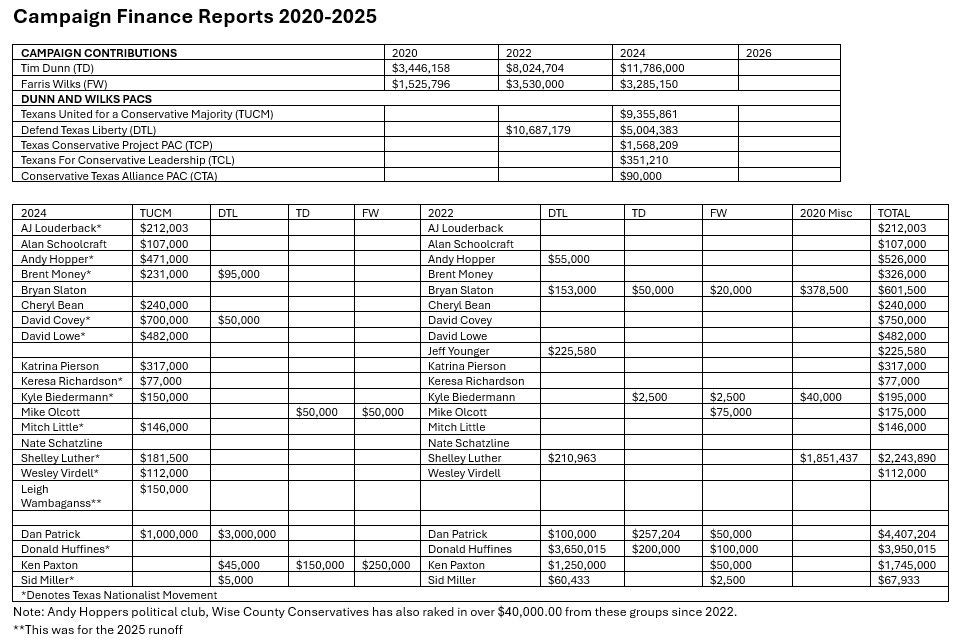
Then look at who consistently:
Votes “no” on damn near everything
Brags the loudest about their fiscal ratings
Echoes Texas Scorecard talking points
Attacks colleagues using machine narratives
It’s the same people.
The overlap is not subtle.
It is not accidental.
And it is not defensible.
The same “usual suspects” who treat fiscal ratings like gospel are the same ones taking money from the same donor network that props up the scorecard itself.
That’s not coincidence.
That’s alignment.
Fiscal Ratings as a Loyalty Program
Once you connect behavior, money, and narrative, the fiscal rating scam snaps into focus.
The rating isn’t just a score — it’s a signal.
It tells donors:
“This one is safe.”
It tells activists:
“This one is pure.”
It tells other legislators:
“Fall in line or this will be you.”
And it tells voters absolutely nothing about whether the person holding office is actually governing.
If fiscal ratings were truly about protecting taxpayers, they would:
Penalize hypocrisy
Penalize earmarks
Penalize performative obstruction
Reward cost-cutting amendments
Instead, they reward obedience.
Dirty Money, Clean Scores
Let’s stop pretending this is complicated.
Legislators who:
Vote “no” reflexively
Take money from the same donor ecosystem
Protect the machine publicly
Enforce its narratives privately
Just so happen to score extremely well.
Meanwhile, legislators who:
Amend bills
Improve outcomes
Support conservative governance
Work for the betterment of their constituents
Refuse to bow to the machine
Magically become “fiscally irresponsible.”
That’s not analysis.
That’s enforcement.
Why This Matters Right Now
We’re not revisiting this just to rehash old fights.
We’re revisiting it because “fiscal ratings” are being actively weaponized right now:
Ahead of primaries
During legislative sessions
In internal party battles
To pre-label who is acceptable and who is not
Just like “votes with Democrats,” these ratings aren’t about past behavior. They are about controlling future behavior.
They exist to tell legislators:
“Vote our way — or we will brand you.”
That isn’t accountability.
That’s coercion.
The Republican Party’s Self-Inflicted Wound
Here’s the uncomfortable truth:
This only works because Republicans let it work.
Too many activists outsource their thinking to “scorecards.”
Too many voters confuse simplicity with truth.
Too many leaders are afraid to challenge the narrative.
And so we get legislators voting “no” on good bills, necessary bills, and usually conservative bills — not because it’s right, but because it preserves a number next to their name.
That’s not strength.
That’s submission.
Final Thought
Now that you’ve seen Inside the Machine, you can’t unsee it.
You can see how the narratives are built.
You can see how the metrics are manipulated.
You can see how money, ratings, and obedience reinforce each other.
So the next time someone waves a fiscal responsibility score in your face, ask the one question they never want asked:
“Show me the work.”
If they can’t — or won’t — then stop eating the shit sandwich.
Because they’re not serving you truth.
They’re serving you control.
And Texans deserve better.
Interesting prose. It’s always fascinating to see a sophisticated critique about shit sandwiches used to paper over a $338 billion budget expansion.
You’ve spent quite a bit of digital ink on ‘The Machine’ and ‘loyalty programs,’ but you conveniently omitted the most important data point from the 89th Session: the Texas budget has expanded by approximately 43% since 2022. During that same period, the combined growth of Texas’s population and inflation was roughly 21%.
When a state’s metabolism is growing at twice the rate of its organic host, a ‘no’ vote isn’t ‘cowardice’ or a ‘ploy,' it is a mathematically sound immune response. To label legislators ‘fiscally irresponsible’ for refusing to bake a 43% baseline increase into the permanent budget is a rhetorical trick that relies on your readers not owning a calculator.
As for your ‘scam’ regarding Journal entries and ‘Statements of Vote,’ you’ve correctly identified the theater but missed the script. Yes, members use House Rule 5, Sec. 55 to record ‘intended’ votes to save their ratings. But that isn't a failure of the scorecard; it's a failure of the House rules that allow members to have it both ways. The scorecard simply forces them to pick a side in the permanent record.
The only valid technical critique you had (the ‘cost of inaction’ regarding infrastructure) was buried under layers of rhetorical baggage. You are correct that scorecards ignore the $2 billion annual resource leak from our aging water pipes. But until you provide an NPV (Net Present Value) analysis showing that the $8.5 billion education increase or the massive budget expansion was actually ‘fiscally responsible’ governance rather than just a different flavor of state-led industry, you’re just serving another sandwich from the same shop you’re criticizing.
Textbook spin. Next time, try grounding the analysis in the raw appropriations data. Texans deserve the math, not the melodrama.